
Quick answer
The federal battery rebate is not ending yet, but it is getting smaller. Under the Cheaper Home Batteries Program, the discount is already set to drop on 1 January 2027 and again every six months until 2030. On top of that, Treasury is reportedly looking at further cuts before the mid-year budget update in December 2026. Nothing extra has been announced yet. If you were already planning a battery, now is a good time to get quotes, because the discount depends on your installation date, not the day you sign.
What's Happening With the Battery Rebate?
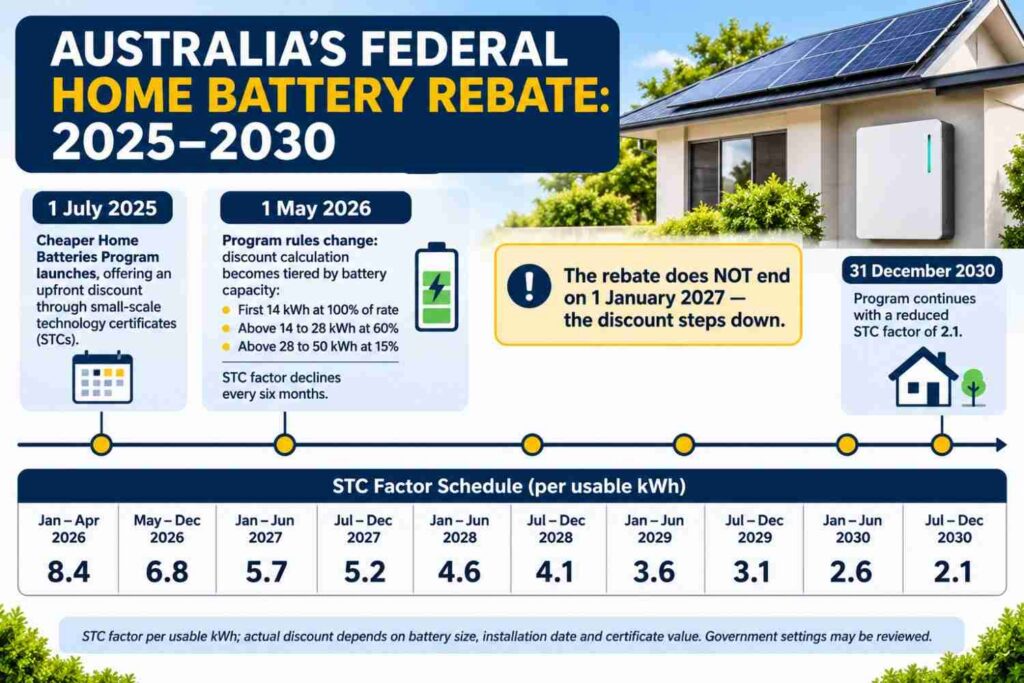
The Cheaper Home Batteries Program started on 1 July 2025. It takes an upfront discount off eligible home batteries through Small-scale Technology Certificates (STCs). Your installer claims the certificates and takes their value off your price.
It has been hugely popular. In November 2026 the Prime Minister said more than 600,000 households and small businesses had used it. That popularity is also why it keeps changing. The government's estimated cost rose from $2.3 billion to $7.2 billion, and the rules were tightened from 1 May 2026.
Now there are two things happening at once:
1. A scheduled drop on 1 January 2027. This is already locked in.
2. Possible extra changes. Treasury is reportedly looking at options to reduce the program's cost ahead of the Mid-Year Economic and Fiscal Outlook (MYEFO) in December 2026. A smaller discount and means testing have both been reported as options.
What's Confirmed and What's Only Reported
| Change | Status (as at 19 November 2026) |
|---|---|
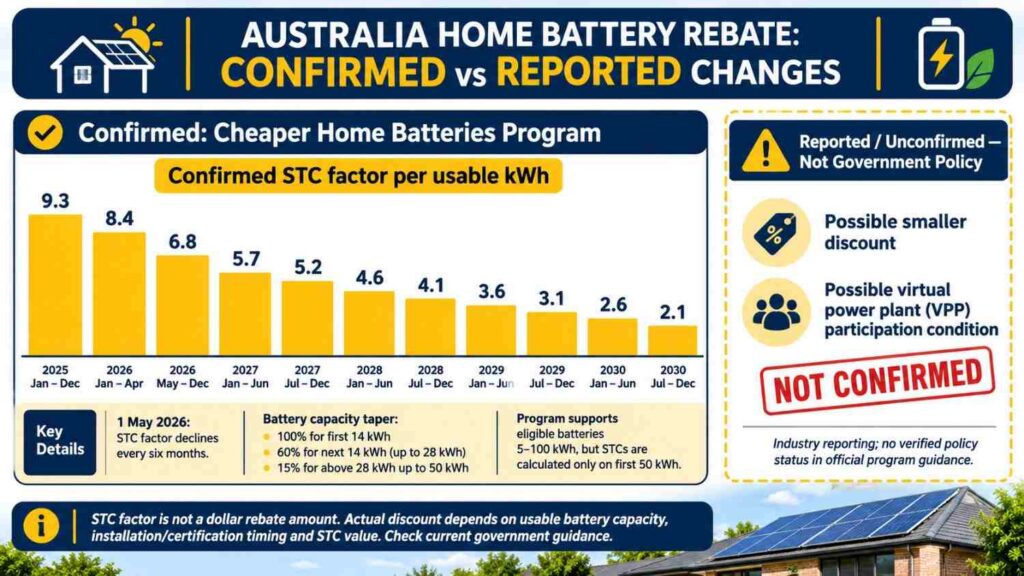
| Discount drops on 1 January 2027 | Confirmed. The STC factor falls from 6.8 to 5.7 certificates per kWh |
| Further drops every 1 January and 1 July to 2030 | Confirmed schedule |
| Tiered discount by battery size (in place since 1 May 2026) | Confirmed. Full rate on the first 14kWh of usable capacity, 60% from 14 to 28kWh, 15% from 28 to 50kWh |
| A smaller discount announced at MYEFO | Reported only. Not announced |
| Means testing (an income limit) | Reported only. No income test applies today |
| Program scrapped | The federal Opposition has called for it to be scrapped. The program continues under current law |
We will update this table after MYEFO.
What the 1 January Drop Means for Your Quote
The number of certificates your battery earns is worked out like this:
Usable battery capacity (kWh) x STC factor = certificates
From 1 January 2027 the STC factor drops from 6.8 to 5.7. That's about 16% fewer certificates for the same battery. It drops again to 5.2 on 1 July 2027.
The tiers matter too. Since 1 May 2026, only the first 14kWh of usable capacity gets the full rate. Capacity above that gets a reduced rate. So for most Brisbane homes, a battery around 10 to 15kWh gets the most discount per kWh. Bigger batteries still get a discount, just less for each extra kWh.
The dollar value also moves, because certificate prices change week to week. That's why we show the certificate count and the discount on every quote, so you can see exactly what you're getting. [Confirm TVS shows both on quotes]
Why Your Install Date Matters, Not Your Sign Date
This catches a lot of people out. The Clean Energy Regulator has made it clear that rebates are based on the installation date, not the purchase date. Paying a deposit in December does not lock in the December rate if the battery goes in after 1 January.
So if you want the current rate, ask for:
- A realistic installation date in writing
- The price if the job slips into January
- Who covers the difference if the delay is on the installer's side
Should You Rush to Beat the Deadline?
Only if a battery already makes sense for your home. The January drop is real, but it's a modest share of the total price. It isn't a reason to buy the wrong system or skip comparing quotes.
A battery is usually a good fit if you:
- Already have solar and send a lot of it back to the grid for a small feed-in credit
- Use a lot of power after 4pm, when Energex peak time-of-use pricing starts
- Want backup power during storms (last week's storms left tens of thousands of South East Queensland homes without power)
- Plan to add an EV or more air-con soon
A battery may not pay off if your evening use is low, your solar system is very small, or you're planning to move soon. A good installer will tell you that.
Watch out for fake deadlines. The program's step-downs only happen on 1 January and 1 July. If a door-knocker or caller says the rebate "ends Friday" or "this week only", that's a sales tactic. Under Australian Consumer Law, door-to-door and phone sales also come with a 10 business day cooling-off period.
What This Means for Brisbane Homes
A few things make the battery decision a bit different in South East Queensland:
- Storm season is here. A battery with backup circuits can keep your fridge, lights and Wi-Fi running in a blackout. Not every battery does this automatically, so ask for backup to be included.
- The Solar Sharer Offer. Since 1 July 2026, retailers in South East Queensland must offer a plan with at least three free hours of power in the middle of the day. A battery can charge in that window and run your home in the evening peak. Check whether that plan suits your usage before you switch.
- Energex approval. Your installer applies to Energex (or Ergon in regional Queensland) before connecting a battery. This adds a little time, so factor it in if you're aiming for a December install.
- No current Queensland state battery rebate. The federal discount is the main incentive for Queensland homes right now. [Check for any new QLD scheme before publishing]
7 Questions to Ask Before You Sign
1. How many STCs does this battery earn, and what dollar discount have you applied?
2. What is the earliest realistic installation date, in writing?
3. What happens to my price if the install moves into 2027?
4. What is the battery's usable capacity, not just its nominal size?
5. Which circuits will it back up in a blackout?
6. Are your installers SAA-accredited with a battery endorsement, and is the battery on the approved product list?
7. Does the price include any switchboard upgrade, meter change or inverter replacement?
If an installer can't answer these clearly, keep looking.
Get a Clear Battery Quote From a Local Team
We've installed solar and batteries across South East Queensland since 2015. Our SAA-accredited electricians handle the Energex approval and the federal discount paperwork, and every install comes with a 10-year workmanship warranty.
Send us a recent power bill and we'll tell you honestly whether a battery suits your home, what size makes sense, and what it will cost after the discount. If December is realistic for your install, we'll say so. If it isn't, we'll quote the January price so you can plan.
Battery Rebate FAQs
Is the federal battery rebate ending?
Not right now. The Cheaper Home Batteries Program is scheduled to run until the end of 2030, with the discount getting smaller every six months. The government is reportedly reviewing further changes, but none had been announced as at 19 November 2026.
When does the battery rebate drop next?
On 1 January 2027. After that it drops again on 1 July 2027 and then every six months until 2030.
Does signing a quote lock in the current rebate?
No. The discount is based on the date your battery is installed and certified, not the date you sign or pay a deposit. Ask your installer for a written install date.
What size battery gets the best rebate?
Since 1 May 2026, the first 14kWh of usable capacity gets the full rate, and larger batteries get a reduced rate on the extra capacity. The right size depends on your evening usage, so we size it from your bill.
Can I add a battery to my existing solar and still get the rebate?
Yes. Batteries added to existing solar are eligible, as long as the battery is on the approved list and installed by an SAA-accredited installer. We check your current inverter and quote the simplest option.
Is there an income limit on the battery rebate?
Not at the moment. Means testing has been reported as an option under review, but no income test applies today.